
What Colour Should a Sikh Groom Wear for His Anand Karaj?
# What Colour Should a Groom Wear for His Anand Karaj?
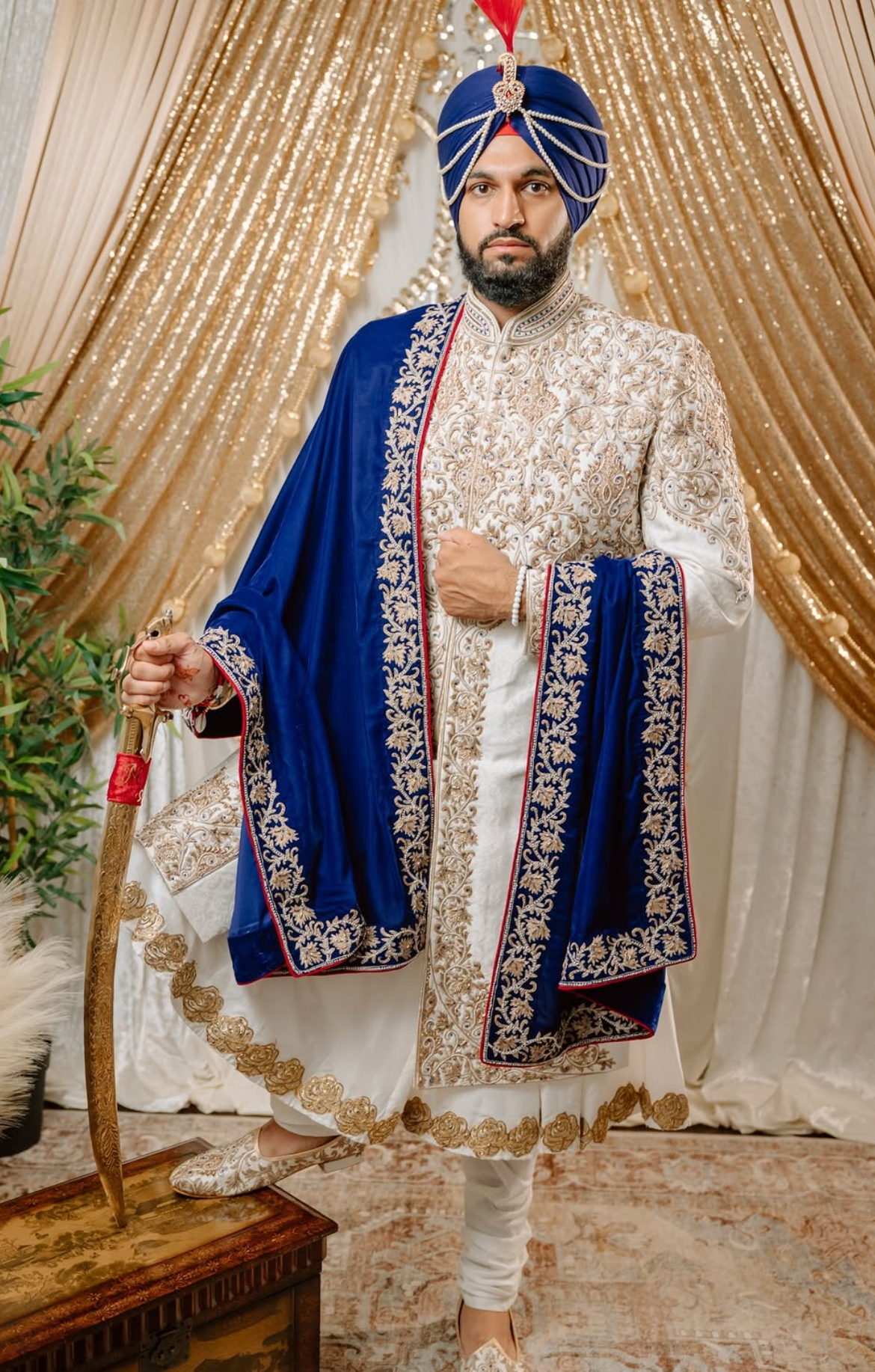
Light, and heavily worked — ivory, champagne, oyster, soft gold — with the real colour decision being the turban rather than the sherwani. Most grooms choosing an Anand Karaj sherwani colour get that order backwards. The sherwani sits in a narrow light band that Anand Karaj grooms land in anyway; the pag carries the colour, sits nearest your face, and is what every photograph is framed around.
## The turban is the decision
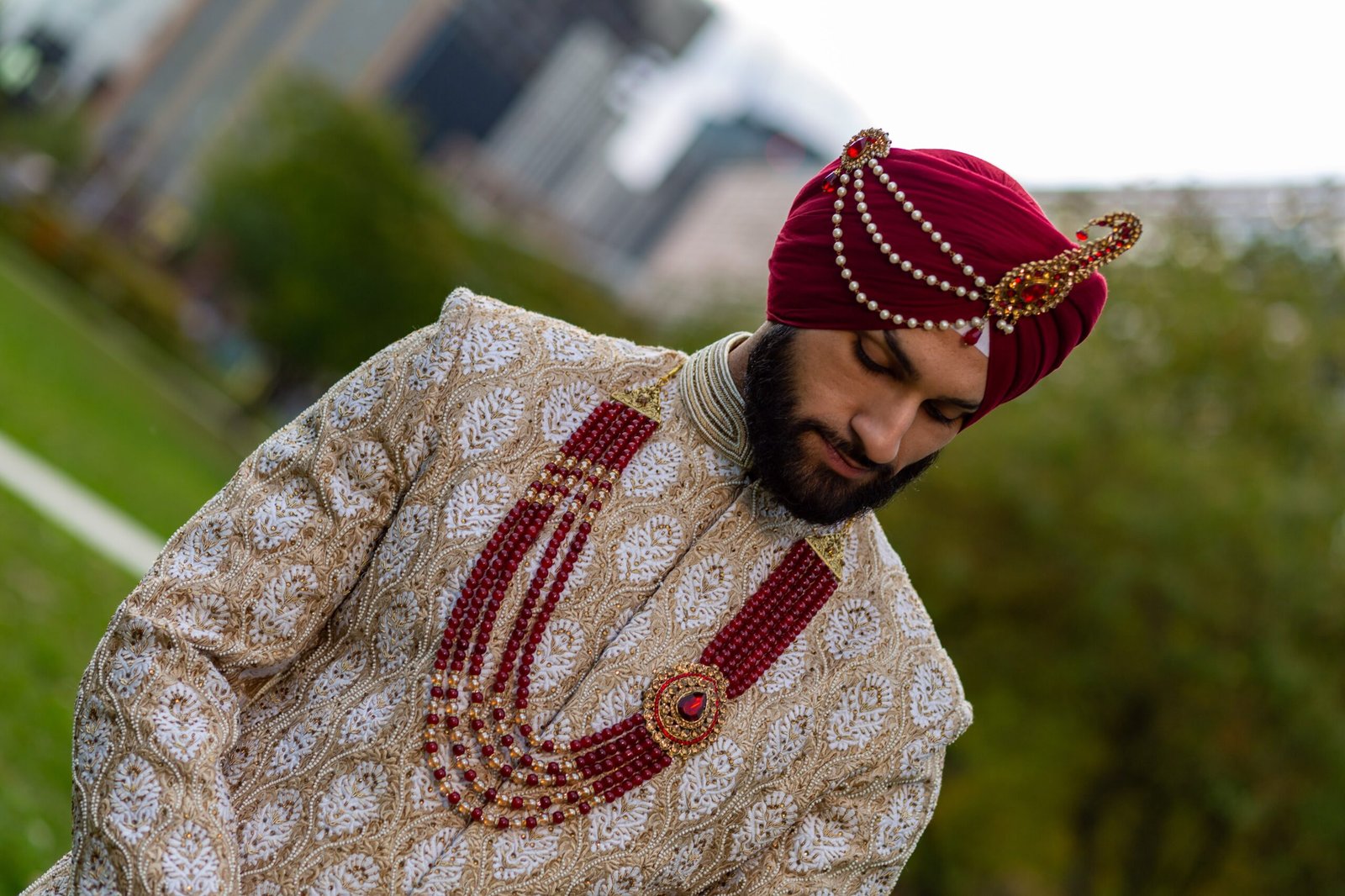
Pick the pag first and let the sherwani follow it. Against ivory or champagne, most Sikh grooms go one of two ways: a pag that picks up the bride’s palette, so the two of you read as a pair without being matched, or a deep contrast — maroon, rust, bottle green, navy — which makes the head the strongest point in the frame and photographs hard.
Then the kalgi on it. The kalgi is not decoration and never was. Jewelled turban ornaments were rank markers worn by rulers and nobility, and by the eighteenth century they were multi-piece compositions in gold, enamel and stones that signalled standing at a glance. A groom wearing one places himself in that line.
## hy the Anand Karaj sherwani colour stays light — and stays ornate
The heritage is warriors and lions, and the reference point is the Sikh Empire in the Punjab under Maharaja Ranjit Singh. A Sikh groom dressing as a Maharaja is paying homage to his own tradition, not putting on a costume.
Which is why we never talk a Sikh groom down from ornate. Restraint is not sophistication at an Anand Karaj — it is a failure to show up as what the day is asking of you. The day takes the full works: the pag, the kalgi, the jewellery, the shawl, the kirpan, and often the belt.
## The belt, which nobody explains
**The belt was the holster the sword sat in. It carries no sword now — it produces the same line, and that line is what reads as warrior.**
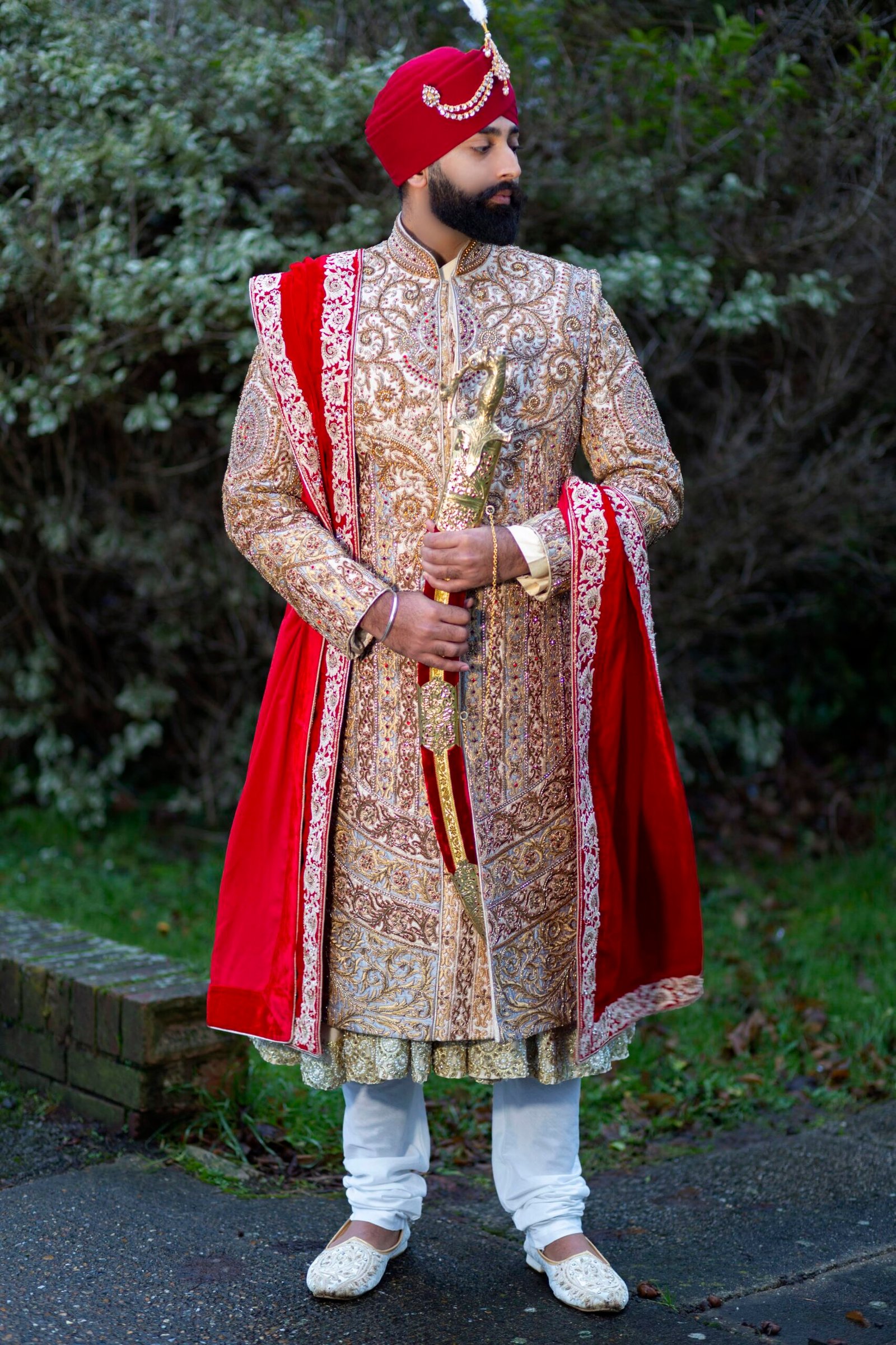
A groom who is told this wears it differently, which is the whole reason it is worth saying out loud rather than selling as a finishing touch.
## Her outfit still sets the shortlist
We never match the bride. We complement her. On an ivory base the coordination happens in the work and the pag, not in matching a colour to her lehenga. Matching is what a hire shop does with a swatch; complementing is a judgement about two people photographed together for the rest of their lives.
## Frequently asked
**Should my pag match my sherwani?**
No. A pag in the same colour flattens the outfit into one block. Contrast it, or tie it to the bride’s palette.
**Can a Sikh groom wear a dark sherwani to the Anand Karaj?**
It is unusual. The Anand Karaj sits light; the dark pieces belong to the reception, which is generally a tuxedo.
**Do I need a kalgi?**
Nothing obliges you to. But it is the ornament with the clearest historical weight, and the detail that reads at distance.
**What about the reception afterwards?**
Generally a tuxedo, and never a second sherwani. Every other man at that reception is wearing a suit off the shelf — a Hugo Boss or an Armani still reads as some guy in a suit.
**How long does the sherwani take?**
Eight to twelve weeks plus fittings. The pag and kalgi are decided in the same conversation.
—
*Bring the date, the venue and, if you have them, pictures of what she is wearing. We start with the pag. Consultations are free at Solihull and Mississauga, or by video.*
