
What Is a Kalgi, and Does the Groom Need One?
A kalgi is the jewelled plume pinned to the front of a turban, and it was historically a marker of rank rather than an ornament. If you are wearing a turban at your Anand Karaj., that is the argument for wearing one.
It is also called a sarpech. The pieces were made in gold with enamel and set stones, and by the eighteenth century they had become elaborate multi-part compositions that signalled wealth and standing. The turban itself carried honour and rank; the plume on the front was the mark that said which man in the room outranked the others.
Why that history still does work
Every man at a Sikh wedding is wearing a turban. Several of them will be wearing good ones. The kalgi is the detail that separates the man at the centre of the day from everyone else who tied a pag that morning.
That is the same test the whole outfit has to pass. Someone should be able to walk into that room and instantly know who got married.
A kalgi does that work in a single small piece, at the height of your head, which is exactly where a photographer is looking.
Does a Sikh groom need one?
Yes, We never talk a Sikh groom down from ornate.
The Anand Karaj groom takes the full set — the most heavily embroidered sherwani in the room, the pag, the kalgi, the jewellery, the shawl, and often the belt. The belt was the holster the sword sat in. Restraint is not sophistication at a Sikh wedding; the day is asking you to show up as something, and the outfit either does that or it does not.
Does a Hindu groom need one?
The jewelled turban plume is well documented in Rajput and Mughal court tradition as well, so it is not borrowed if a Hindu groom wears one. Whether it suits your day depends on the rest of the outfit and on what your family expects, and that is a conversation rather than a rule.
Does a Muslim groom wear one?
The sarpech is as much a Mughal court piece as a Rajput or Sikh one, so there is no question of borrowing. In practice it depends on whether you are wearing a turban at all — many Nikah and Walima looks are not turban-led, and a kalgi has nowhere to sit without one. If your Barat does take a turban, it belongs there.
Choosing a kalgi
Three things matter, and none of them is the price.
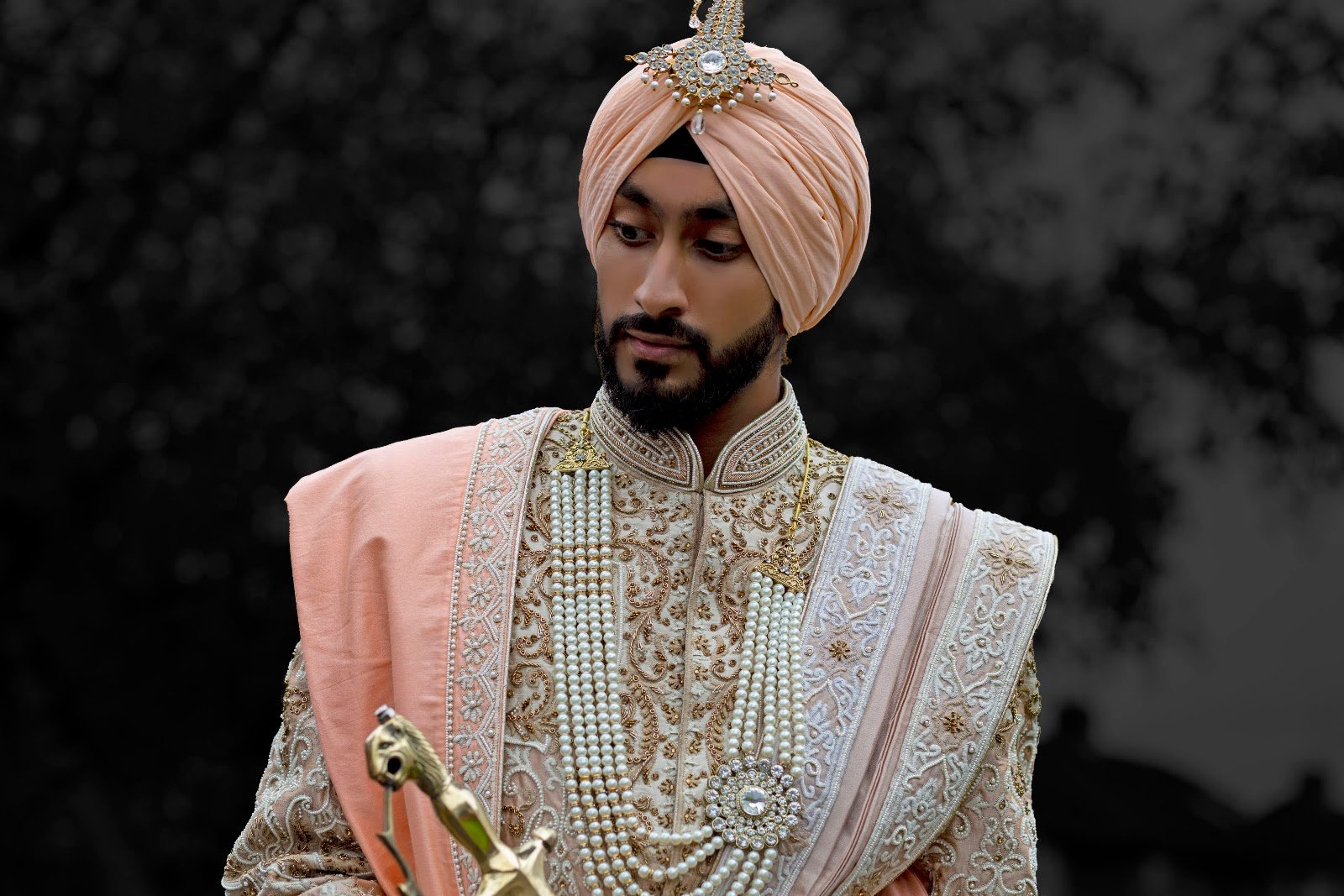
Scale. A kalgi is sized against the turban, not against the sherwani. A large piece on a compact pag looks unbalanced, and it is the most common mistake we correct in the showroom.
Weight and fixing. It sits on fabric for a long day and it has to stay where it was put. The fixing matters more than the stones.
What it sits next to. The kalgi should agree with the sherwani’s metalwork — the embroidery thread, the buttons, the belt if you are wearing one. It does not need to pick up a colour from the bride’s outfit. We never match the bride. We complement her, and that judgement is made across the whole look rather than piece by piece.
We hold kalgis at both showrooms, and they are usually chosen at a fitting with the turban tied, because that is the only way to see the proportion properly.
UK: /book-consultation-uk/
Canada: /book-consultation-ca/
US and Gulf countries: /blogs/virtual-sherwani-consultation/
